Wednesday, June 26, 2013

Recreating the Indian Mutiny in the Potting Shed


We interrupt our usual episode-blogging for a special announcement:  the lost episodes from the first (1961) series of The Avengers are being recreated for audio (happily, the scripts still exist) by Big Finish, the company best known for its Doctor Who audios; details here and here.

Yes, I’ll be blogging them too once they’re released. 

Monday, June 24, 2013

A Surprising Faith in Gentlemen’s Agreements (Mr. Teddy Bear)


location:  Avengers ’62, vol. 1
airdate:  29 September 1962

The tv show begins with ... the shooting of a tv show:  a man is about to be interviewed in a studio; he opens his mouth to speak, and falls to the floor, dead.  The cameras – both those we see and those we don’t – close in on his dead face.  Cue the credits, after which we start with a closeup of an anatomical cutaway of a human face.  Pan right, and we see a living face – Steed’s.  And throughout the episode, Steed and Gale are constantly being watched by cameras. 

Thus series 2 starts with the surrealism and self-awareness that was not much in evidence in series 1 but will become the norm later in the series.  And our main duo is now Steed and Gale, not Keel and Steed; for this is the first episode of the Cathy Gale era (to be specific, the first to air, not the first made; but here, as in my Danger Man and Star Trek blogs, I’m going through the episodes by airdate, not production date).

Whereon hangs a tale.  The gap between the first and second series was nearly a year, the delay being due to an industrial dispute. (As I’ve explained elsewhere, I prefer not to say “due to a strike,” since to treat workers’ unwillingness to meet employers’ terms, rather than employers’ unwillingness to meet workers’ terms, as the cause of the delay is to acquiesce in the normativity of employers’ getting their way as the default, that which stands in no need of explanation or justification.)  According to Patrick Macnee:

The dispute was between the British Actors’ Equity Association and Independent Television.  Before the birth of ITV in 1955, acting on television – BBC television – had been accepted as an extension of straight theatre work or film work.  When ITV came into being the situation changed.  Viewing figures (ratings) became a consideration.  As programmes began to reach a larger audience, the ITV companies saw their profits increase dramatically and Equity decided that its membership should receive a bigger slice of the cake. ... [T]hey were demanding an increase in the minimum fee paid to artistes for programmes seen on the network, additional increases for shows that were partially networked and a much higher rehearsal fee.  (The Avengers and Me, p. 29)
 
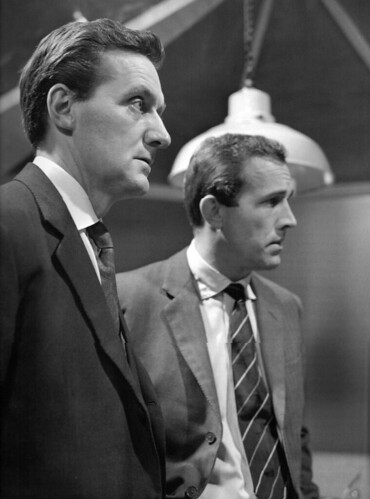
In any case, by time the industrial dispute was over the following year (a compromise was reached), Ian Hendry was gone – whether quit or fired is disputed.  It appears to have been Sydney Newman who suggested that the new partner should be a woman; but the distinctive, role-reversal combo of action heroine and dandy male seems to have emerged – gradually – at least in part from the initiative of the actors themselves (though the fact that Honor Blackman’s dialogue was written as though for a man obviously helped).  Paul Cornell writes:

Patrick Macnee, at this point, makes one of a series of wonderful decisions.  At the same time as Cathy is being empowered, he starts to put aside elements of his own power as a hero (his gun, his fisticuffs, his wisdom) in order to give Mrs Gale more of the spotlight.  I say Macnee rather than Steed, because, from interviews, it becomes obvious that Macnee had very definite and laudable aims in mind, ones that were sometimes utterly at odds with the show’s producers. (Avengers Dossier, p. 346)

And according to Macnee (Blind In One Ear, p. 223), he and Blackman developed the idea that their characters should address each other by their last names.  (Macnee – like that other spy-fi Paddy Mac, Patrick McGoohan – would also eventually refuse to have his character use a gun, at least regularly.)

The show’s much-vaunted “feminist” aspect (such as it is, of course) begins not with Emma Peel but with Cathy Gale (and actually recedes a bit with Peel, as we’ll see to say nothing of Diana Riggs own antifeminism).  Gale quickly establishes herself as determined, competent, and unflappable; in one scene, she evades a man who’s been tailing her by disabling his motorcycle in a manner that displays a working knowledge of motorcycles that few 1960s tv shows would have given a woman character.

Honor Blackman describes her character as “the first feminist to come into a television serial; the first woman to fight back.”  (quoted in Kathleen Tracy, Diana Rigg: The Biography, p. 49)  And Macnee reports a fan letter from a feminist thanking him for his efforts to “further our emancipation” via the “unusual degree of intelligence and civilization” with which he treated his female co-stars.  (Blind In One Ear, pp. 268-9)  Though one has to say that Steed’s air of mocking superiority toward Gale through most of this episode doesn’t fit that picture terribly well; through most of the episode he seems to be enjoying their banter a good deal more than she is.  Still, it’s early days yet.  (And since I haven’t seen many episodes from the Gale era, I don’t really know what to expect in the future.)

TOP:  Good.   BOTTOM:  Not good.
Gale is introduced without preamble, as though she and Steed have been working together for some time (and we are free to imagine that they were, in between Steed’s adventures with Keel); and her status as “Mrs.” Gale is initially unexplained.  The sexual-or-not nature of their relationship is teased with a scene in which Steed and Gale are rolling in the floor in one another’s arms – which turns out to be martial arts practice.  Steed’s attempt (forcefully rebuffed) to kiss Gale during this practice suggests that the attraction may be real but one-way.

To viewers of the 1998 Avengers movie, the title “Mr. Teddy Bear,” and prospect of a villain using a teddy bear disguise, will inspire fear and dread.  But be of good cheer:  what the movie handled execrably, this episode manages well.  The eponymous Mr. Bear, a professional assassin of unknown appearance, leads our leads on a cat-and-mouse chase through a surreal landscape of Scooby-Doo houses filled with weird props (including cigarettes with chimpanzee fingerprints on them).  

The feel of a “romp” is encouraged by the cheerful, indeed gleeful, almost amoral way that Steed revels in the ingenuity of Bear’s crimes.  But the episode has darker moments, especially toward the end with the tense strategy game between Steed and Gale (which will remind Sherlock fans of a similar scene in “A Study in Pink”).

This episode gives us our first look at Steed’s supervisor (codenamed 110 – perhaps a nod to 007?), as well as of Steed’s dog (a Dalmatian named Freckles, who incidentally proves to be utterly useless as a watchdog).

Budget constraints – particularly the no-retakes-unless-absolutely-necessary policy – show themselves when Agent 110 – or rather the actor playing him – accidentally calls Gale “Jail” (well, “Gaol,” I suppose).  I also suspect that the automatic cigarette case was supposed to open before, rather than after, Gale refused the cigarette.  

Until next time, keep the champagne cold and your bowler on!

Thursday, June 13, 2013

How They Must Shake When You Walk In and Over Them (The Frighteners)


location:  Emma Peel Bonus Disc (also available in the 17-disc 2006 Emma PeelCollector’s Megaset but not the 16-disc 2001 Emma Peel Megaset)
airdate:  27 May 1961

We begin with a shot of (probably) a real building – which then gives way to a shot of a model building inside the real building. 

It’s an apt symbol to kick off an episode in which everybody is putting on some sort of false front.  Jeremy de Willoughby (essentially an updated version of P&P’s George Wickham, and the similarity in names may be no coincidence) feigns love for Marilyn Waller while hiding his true mercenary intentions; Marilyn hides from her father, Thomas Waller, her plans to elope with Willoughby, while the father hides from his daughter his criminal connections, and specifically his plans to have Willoughby beaten to a pulp.  

The good guys do likewise, beating the bad guys through trickery rather than force (well, for the most part) – convincing one criminal that his neck is broken, and another that a hypodermic is filled with acid, and finally bringing in an actress to persuade Marilyn that Willoughby has abandoned his sainted mother and so is unsuitable as a husband.  Steed in particular morphs so effortlessly from one role to the next (helpful friend, menacing captor, gay chaperone) as to leave us wondering whether anything we see of him is genuine.

“The Frighteners” is the last surviving episode of season 1, and our (though not the original audience’s) first encounter with Steed.  He’s a darker, more ambiguous figure than the Steed we’ll know later:  not yet the central figure, but rather a mysterious trickster who lurks in the margins of the narrative, intervening unexpectedly when necessary.  Keel is the sorcerer’s apprentice, who gets chided by Steed for trying to tackle, on his own, some risky trickery that Steed feels Keel isn’t quite ready for.  (When Sydney Newman suggested that Steed’s clothing was boring, Macnee responded by abandoning his leather jacket for a dandified ensemble complete with bowler and umbrella.)

The title “The Frighteners” is multiply ambiguous.  First, to “put the frighteners on” somebody is, in British usage (I explain for my North American readers), simply to scare or intimidate them; despite what the wording might suggest, it doesn’t imply sending other people to do the scaring.  But second, Waller does send other people to do his scaring for him, and so the thugs he hires are themselves literal “frighteners.”  Finally, Steed and Keel through their trickery become “frighteners” themselves, as they manage to scare Waller’s frighteners into giving up information on Waller; scare Waller into not hiring any more frighteners; and – through their truth-within-a-lie illusion – cause Marilyn to become scared of Willoughby.

Some of Steed’s and Keel’s trickery is morally problematic.  When Steed in effect threatens to torture a captured prisoner, Keel’s criticism is rather mild: “no more applied psychology – not on the premises.”  The final deception involving the actress is fair sauce for Willoughby, but a paternalistic trick on Marilyn.  Indeed, Marilyn is never allowed a single autonomous choice; she begins as the dupe of Willoughby, becomes the prisoner of her father, and ends as the dupe of Steed and Keel. All the same, the protagonists’ reliance on trickster-heroics rather than weapons gives them a moral distance from their opponents, who lovingly fondle their brass knuckles (Moxon, Deacon) or their more abstract corporate equivalents (Waller).

Willoughby’s mistake, by the way, when the actress impersonating his mother is introduced, is to act the way one would expect him to act if her story is true.  Rather than turning his back on her in embarrassment, he should have relentlessly quizzed her as to who she was and who she was working for – which might have dampened Marilyn’s suspicions.

One of the delights of the episode is “the Deacon,” a crime boss played by Willoughby Goddard (not to be confused Willoughby the character).  The Deacon, ensconced in his hideout behind a literal false front, gets many of the best lines (often to the accompaniment of Beethoven’s Pastoral Symphony).

Some of these play with analogies between crime and politics  The Deacon tells one of his thugs who’s worried about getting another crime on his rap sheet:  “Thinking of retiring, Moxon?  That’s laziness for you – that’s the welfare state.” He warns the same thug not to beat up the wrong target with the words “We don’t want to go wasting expensive treatment on the wrong taxpayer,” and considers what to do “if the patient doesn’t respond to treatment.”  In short, the Deacon is using the socialised medicine of which he apparently disapproves as a metaphor for his own criminal enterprise.  (Steed continues this medicine analogy when discussing the “therapeutic value to the patient” of being beaten up.)

The Deacon is also fond of analogies between crime and business, as when he describes himself and Waller as fellow executives having to deal with annoying “little people,” or jokes about listing the need to beat people up as an expense on one’s income tax.  (Steed again joins in when noting that there’s “more to takeover bids than the polite board meeting,” though this time he may have in mind actual rather than analogical connections.)  But the Deacon, as befits his title, can stretch as well to Biblical metaphors, exhorting his thugs to “smite the Egyptian, smite him hip and thigh” (an amalgamation of Exodus 12:23 with Judges 15:8), and to pagan metaphors too, as when he calls his thugs his “gladiators.”

As with the unseen dog-stroking villain in “Hot Snow,” the Deacon’s possession of a parrot suggests an anticipation of the Bond movies (the scriptwriter for this episode, Berkely Mather, would go on to be one of several contributors to the screenplay of Dr. No the following year), as does the cash register’s secret key combination that opens the hidden door to Deacon’s lair.  The use of the parrot might also be inviting us to connect the Deacon with Sydney Greenstreet, if we’re allowed to run together The Maltese Falcon’s Greenstreet-the-cultured-and-garrulous-crime-boss (albeit somewhat more affable than the Deacon) and  Casablanca’s Greenstreet-with-a-parrot.

We get a bit more witty banter in this episode than in “Girl on the Trapeze” – and not just from the Deacon.  For example Keel, when told by Steed “Good of you to come,” replies “So I thought too.”  Later on Steed, when asked “Can’t you read?” as he forces his way past a “Closed” sign, replies:  “I suffer under the disability of a public school education.” (In America, “public” schools are state schools, and the joke would be about declining educational standards in such schools; but in Britain “public” schools are private schools, traditionally associated with the upper class, and the joke, I suspect, is double, with the real joke “that’s why I learned to barge in as if everywhere were my property” concealed in the false-front joke “that’s why I didn’t learn to read.”)

Miscellaneous observations:

It is finally settled that Wilson is indeed a nurse (and strongly hinted that she is in love with Keel). 

Those who recall the show’s later ban on black characters and uniformed policemen will be struck by the appearance of both in immediate sequence here.

The cool manner in which Keel faces down Waller’s bluster when visiting his office is enjoyable, though the slight Keel’s victory in arm-wrestling over the beefy Waller is a bit surprising.

Steed’s suggestion that Keel (Ian Kendry) “give the police surgeon the night off” is a nod to Kendry’s previous series, Police Surgeon.

Nigel the guitar-playing con man is a fun character; one wishes he had more screen time.

The way the two leads stop to pet cats and talk to birds is rather charming.

Is that a sketch of the Florence Duomo in Willoughby’s apartment?

The episode ends as the show will go on, with the celebratory pouring of alcohol (though not yet champagne).

Speaking of which:  until next time, keep the champagne cold and your bowler on!

Saturday, December 17, 2011

A Pretty Dangerous Way of Making a Living (Girl on the Trapeze)

location:  Emma Peel Bonus Disc (also available in the 17-disc 2006 Emma Peel Collector’s Megaset but not the 16-disc 2001 Emma Peel Megaset)
airdate:  11 February 1961

[As always:  SPOILERS BELOW.]

A live woman jumps into the river.  Moments later, a dead woman is fished out of it.  But are they the same woman?

This episode, the sixth one broadcast and the first to survive in its entirety, was written by Dennis Spooner, who would later work on such shows as Doctor Who, The Baron, and Remington Steele;  the episode was long believed to have been transmitted live and so never recorded – until a recording showed up in 2001. 


In one respect, “Girl on the Trapeze” is even less like the show that The Avengers would eventually become than “Hot Snow” was:  namely, Steed isn’t even in it.  But in numerous other respects it makes significant advances toward the show’s future:  a) the plot involves international intrigue, not just ordinary crime (the point of the switcheroo is to kill a potential Soviet Bloc defector and smuggle out a hostage in her stead); b) the main setting (a circus) is an attempt at an unusual, visually interesting location (even if, thanks to budgetary constraints, all we really see of the circus is a twitchy clown, a few sad-looking animals in cages, and some brief clips of stock footage); c) the plot events are likewise quirkily strange (women’s bodies, whether living or dead, multiply interchangeably, as #1 is switched for #2, #2 for #3, #3 for #4, and #4 for #1 again); and, most portentously, d) Ian Kendry’s Keel is partnered with a female investigator, Carol Wilson, who despite inheriting the is-she-a-nurse-or-a-receptionist? role from the murdered assistant in “Hot Snow,” happily gets to do more than just get menaced and/or rescued (though she gets to do those things too). 

While Wilson (played by Ingrid Hafner, who had a somewhat similar role opposite Hendry in Police Surgeon, the semi-predecessor to The Avengers) is less of an action hero than her successors, she does get a couple of action-hero moments (the first one is supposed to be a surprise twist, though it takes little imagination to see it coming, particularly if one keeps Chekhov’s Rule in mind).  Keel does behave somewhat patronisingly toward Wilson – but in a way that, as I read those scenes, does not seem to have the show’s endorsement.  The move toward a partnership of equals progresses slowly ....

Until next time, keep the champagne cold and your bowler on!

Friday, December 16, 2011

I’m Afraid the Girl Will Have to Go (Hot Snow)

location:  Emma Peel Bonus Disc (also available in the 17-disc 2006 Emma Peel Collector’s Megaset but not the 16-disc 2001 Emma Peel Megaset)
airdate:  7 January 1961

[I include the Amazon links mainly for informational reasons; you can often find the sets more cheaply elsewhere, for example on eBay.  It is to be hoped that A&E will eventually bring the series back into print.

This is my blog about The Avengers.  If you want my blog about Danger Man / The Prisoner, click here.]


In the early 1960s most British tv shows were shot on videotape rather than film (even as the American market had largely gone over to film, especially for dramatic series aired in prime time).  Video had its disadvantages – it didn’t look as good, and it was (at that time) much more difficult to edit, meaning that shows essentially had to be shot in continuous sequence, almost as though they were live broadcasts (though in a medium that still relied heavily on actually live broadcasts, and where most of the actors came from a theatrical background, this constraint was largely taken in stride). But video also had the important advantage of being significantly less expensive than film – hence its popularity in a Britain still recovering from the postwar austerity of the 50s.

Unfortunately, one of the reasons that videotape was less expensive was that, unlike film, it could be reused.  In a culture of live performance, and in the absence of a home video market (or of technology enabling same), it became standard practice to show an episode once and then tape over it.  As a result, thousands of episodes from this period are lost forever.  (The devastation thereby inflicted on the Hartnell and Troughton eras of Doctor Who is especially well-known.)


The first season of The Avengers was one of the victims of this practice.   A few episodes were actually broadcast live and so never recorded, while most were recorded but then later taped over or otherwise destroyed.  Thus out of 26 episodes, only two (together with the first 15 minutes of a third) survive.  For some reason, these surviving episodes are available (in North America at least) only on the Emma Peel Bonus Disc, despite having absolutely nothing to do with Emma Peel.

Indeed these early episodes are about as far from the familiar Emma Peel era as one can get.  To begin with, the main character is a Dr. David Keel, while Steed gets second billing and no ass-kicking female partner is in sight at all. (Ian Hendry, the actor playing Keel, had played a somewhat similar character in the earlier show Police Surgeon – another victim of reused videotape, as only one episode from that series survives.)  The production values are noticeably lower (the Emma Peel era, filmed rather than taped, would owe its bigger budget and consequently slicker look to the American market), and the shows are more realistic, with none of the surrealism and self-referencing that would later come to characterise the show.

In those later years, the show would develop a highly stylised format, and all elements that might remind the viewers (i.e. white middle-class viewers, presumably) too much of gritty reality were officially prohibited to the scriptwriters.  The list of prohibitions would famously range from the repugnant (no black characters) to the baffling (no uniformed policemen).  (The fact that two of Steed’s first partners would be an actress named Blackman and a character named Dr. Martin King – both white of course – is a strange irony.)  Two of the chief elements of this first episode – drug use, and female murder victims – would likewise be excluded, the first implicitly and the second explicitly.  (If the title “Hot Snow” had shown up during the Emma Peel era, it would almost certainly have been a reference to a diabolical weather-control plot, not a drug reference.)


“Hot Snow” begins with what looks eerily like a scene from the opening sequence of The Prisoner, with an ominous black car pulling up beside a building in a London street.  A man emerges and breaks into the building, which turns out to house the office of two doctors – our Dr. Keel and his senior partner, Dr. Tredding – and an assistant, Peggy Stephens, who works for both and is engaged to Keel.  (It was unclear to me whether Stephens was simply a receptionist or also a nurse.  Katherine Woodville, the actress who played Stephens, would later make the mistake of marrying Macnee.)  The burglar is after a shipment of drugs that was accidentally delivered to this address; unable to retrieve it, but learning that Stephens remembers the man who delivered it, he reports back to his gang and they decide to kill Stephens so that she’ll be unable to identify the deliverer once the package is identified as drugs.  (The gang is an interesting set of characters – a thug, a nervous wimp, and a dandy who frequents jewelry shops, all reporting by telephone to a criminal mastermind of whom we see only the hands, holding and petting a dog.  This is often supposed to be a Blofeld reference, but that is chronologically impossible; “Hot Snow” came first.)  Keel and Stephens meet to pick out an engagement ring, a drive-by shooter picks Stephens off , and she collapses in Keel’s arms, dead.

And there it ends, for “Hot Snow” is the episode I mentioned of which only the first fifteen minutes survive.  Fifteen Steed-less minutes, I should add; Patrick Macnee’s first scene as Steed has been lost. 


We do know roughly what happens next.  In the course of investigating his fiancĂ©e’s death, Keel runs across Steed, who is investigating the same gang in his capacity as government agent.  Steed inveigles Keel into a plot to infiltrate the drug gangs.  By the end of the second episode (entirely lost), the murderers have been brought to justice, Peggy’s murder has been avenged (hence the name of the show, which makes sense for the first two episodes but never again), and Steed and Keel have agreed to work together from time to time in the future.

(Keel – like Cathy Gale after him, and Emma Peel after her – would not be working for Steed or his (never named) organisation; Steed’s partners were all, in the words of the later American intro, “talented amateurs,” i.e. unpaid freelancers.  And although we would occasionally meet Steed’s code-named superior, until the Tara King years Steed would often appear to be working entirely on his own authority.)

Given that The Avengers would later be famous for its indomitable heroines, it’s notable that the show’s first female character, though evidently intelligent and assertive (indeed the gang members comment that she’s no fool), is an utterly passive victim killed off in the first act – in effect, a “woman in the fridge,” that is, a female character who exists only to be killed as a plot device to motivate the hero.  Things would get better.

It’s frustrating that we can’t see the beginnings of Macnee’s characterisation of Steed.  Macnee has frequently commented on the singularly uninformative direction the script gave him for his first appearance – “Steed stands there” – and how it gave him the freedom to shape the character as he liked.  Hendry’s insistence that he and Macnee should attempt to add more dimensionality to their episodes than was explicit in the scripts was something that Macnee would continue with his subsequent co-stars.

Although the suave and urbane wit which would characterise the show at its height is not much on display in “Hot Snow,” the lost portion of the episode did apparently contain the following exchange:
KEEL:  How did you get in?
STEED: Through the window.  My apologies.
KEEL:  Please don’t mention it.
(Reported in Patrick Macnee, The Avengers and Me, p. 20.)

Until next time, keep the champagne cold and your bowler on!